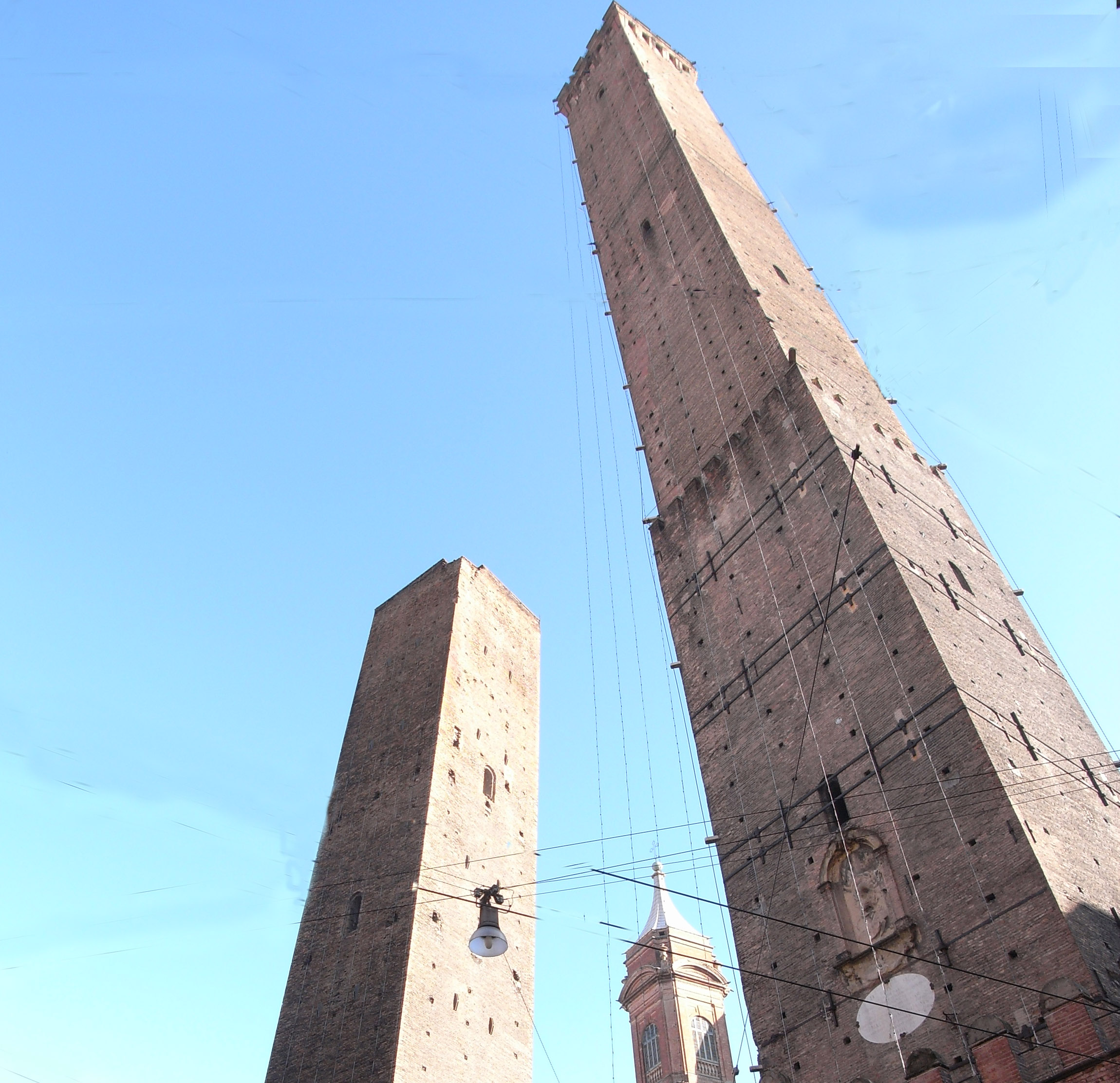
Wrought, or worked, iron is shaped with a hammer while hot. It can be repeatedly re-heated and shaped, constantly becoming stronger. Early examples of wrought iron have been found in Egypt and Mesopotamia, dating from around 3,500 BCE. The Iron Age, around two thousand years ago, saw its common use for making tools and weapons in the Mediterranean area, India and China.
In the area around Bologna, the Etruscans were working in iron 2,500 years ago.

From the early 13th century, the use of wrought iron in Italy expanded to protective and decorative uses. Ironwork progressively became ever more elaborate, and its use was common up to the Art Deco period.

In common with most European cities, many fine examples of wrought iron, ferro battuto in Italian, can be seen while walking around Bologna. In this post, I’ll look at examples from various times past which will give the visitor an idea of what to look out for while walking around the city.

Building security
Windows
Probably the most common use of wrought iron to be seen when walking the streets of Bologna is the window security grill, with surviving examples up to at least 700 years old.


The main doors of some palazzi had small barred windows, allowing the door keeper to see who was outside before opening them.


Amongst Bologna’s barred windows of various sizes are ones of curious round shapes.


Wrought iron grills are used on the semi-circular fan light windows .


Gates
Most of the historic large buildings of Bologna feature carriage entrances to their large internal courtyards. The outer wooden doors are often left open to allow ease of access, and to provide ventilation in summer, giving the passer-by a glimpse into the courtyard.


Even more elaborate are the gates used in churches to restrict access and protect artwork in side chapels. If you’re visiting the Basilica of San Petronio, perhaps to watch the sun’s image to pass the meridian line, you’ll see many fine examples.

The gates of walled towns such as Bologna were closed at night. It was possible to enter the city via several canals, and these were secured by dropping an iron grill into the canal. One surviving example is located at the end of Via della Grada where the Reno Canal enters the city. For more on the city walls, see my post The Walls of Bologna.

Lamps
Whilst streets in medieval times were largely unlit, the survival of torch holders on the facades of some large homes and institutional buildings is evidence that there were exceptions.
Fine examples, both in the form of a dragon, can be seen at Palazzo Pepoli, built as a private home in the 14th century, and at the Collegio di Spagna which also dates from that time.


In Bologna, oil street lamps were in use from 1801, followed by much more effective gas lighting from 1847. By 1866, there were over 1,500 gas street lights, and 8,000 private gas lamps which were replacing candles and oil lamps. Large buildings also had lighting for staircases and major corridors.
Most of these lamps were made of wrought iron.

Wrought iron lamps from the 19th century are common along Bologna’s porticos, which I describe in another post. The introduction of electric lighting gave rise to another period of wrought iron lamp manufacture.


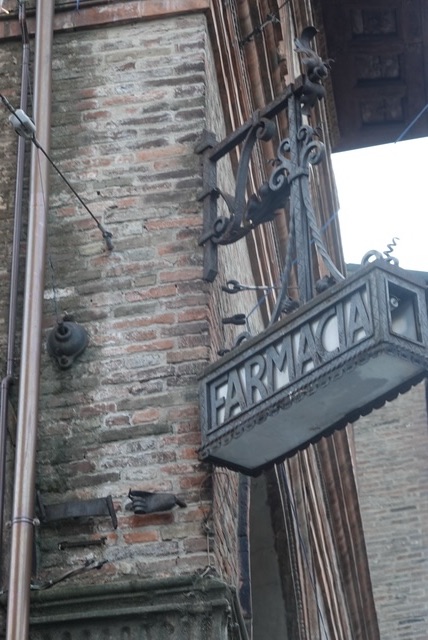
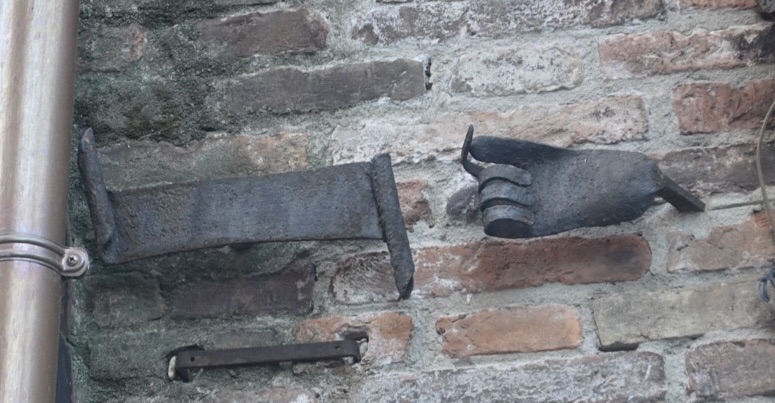
On the corner of Via Rizzoli and Piazza Nettuno you’ll find one of Bologna’s most extravagant wrought iron lamps, designed in 1920 by Gaetano Samoggia.

In 2012, a system was installed that allowed two of Bologna’s major hospitals to flash the light every time a baby was born, an idea copied from the Belgian city of Ghent. This seems to have been in operation only for about 5 years.
Balconies
Ornate balconies have long been a feature of Bologna’s larger palazzi. A very well known and admired one in Via D’Azeglio graces the facade of the 15th century Palazzo Bevilacqua Ariosti, which hosted some of the sessions of the Council of Trent.

The use of cast iron for balconies continued through the centuries and enjoyed a further period of popularity in the art nouveau era.


Horse tethering rings
When cities depended on horse drawn transport, hitching posts and tethering rings were common. If you keep an eye out, you’ll see some surviving wrought iron tethering rings on your walks around Bologna.


The Collegio di Spagna
The Royal College of Spain, in Spanish Real Colegio de San Clemente de los Españoles, was completed in 1367, and since then has been home to Spanish students studying at Bologna University. Amongst its alumni are Saint Francis Loyola and Miguel de Cervantes, who wrote a short novel drawing on this experience. The building demonstrates well the use of wrought iron in medieval and renaissance times.


Shop signs
Wrought iron shop signs were popular in the 19th and 20th centuries. An attractive example is that of the wine shop of the Olindo family in Via Altabella, which has been in this location since 1934. Its sign features a traditional fiasco, or wine bottle, in a straw basket,


The Certosa Cemetery
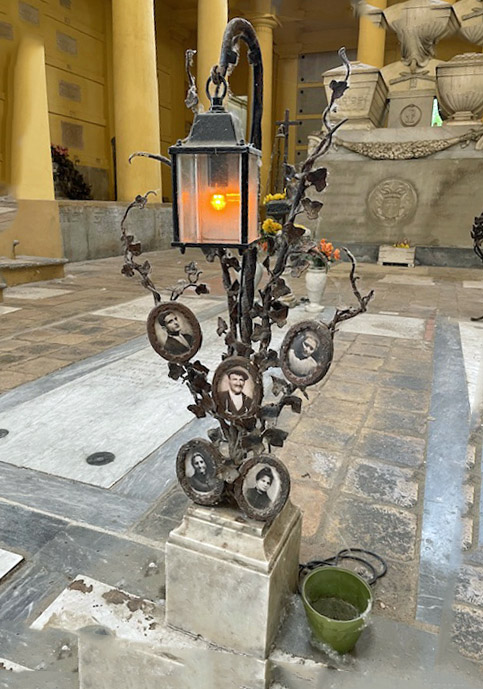
I described Bologna’s monumental cemetery in a previous post. If you pay a visit, you’ll notice many examples of the use of wrought iron.


Art Nouveau
The Art Nouveau style, commonly known as “Stile Liberty” in Italy, brought with it a revivial in the use of wrought iron. New technology such as oxy-aceletene welding gave artists greater freedom in design. Bologna has many examples of wrought iron work from this period, typically incorporating depictions of plant stems, leaves, flowers and fruit.


Via Audinot
In the early 1900s, the city began to grow beyond its 14th century walls (see my post “The Walls of Bologna” ). In 1904, the Milanese architect Paolo Sironi began a new suburban development just beyond the line of the walls and built numerous buildings in the art deco style. Many of these can be admired today along Via Audinot and Via Roncati.


Blacksmiths and wrought iron artists
In the past, the blacksmith, or fabbro in Italian, played an important part in society, and as with the surname “Smith” in English, the Italian equivalent surnames of Fabbri and its variations are common. The Guild of Fabbri played an important role in the city and had a monopoly on the buying and selling of coke and coal.

With the revival in popularity of wrought iron late in the 19th century, a number of well known artist-artisans were active in Bologna. Amongst these was Ravenna born Sante Mingazzi whose studio sign is preserved at the Davia Bargellini Museum.

One of Mingazzi’s well known works from the early 20th century is the awning at 34 Via d’Azeglio, which at the time was the location of a pastry shop. It features corbels with intertwined bunches of grapes and pomegranates.

Surprisingly, in Via Caldarese, just a few minutes walk from the twin towers of Bologna, there is still a wrought iron workshop. It’s been run by the Prata family for three generations, and the founder Antonio Prata was a student of Mingazzi. If you’re lucky, you might find it open for visitors.


© P. Granville 2024
 Bologna on Foot
Hey Paul,
This is brilliant, such beauty in the everday,
Well done & best wishes
Phill
LikeLiked by 1 person
Thanks Phill I hope all is well with you and family
LikeLike