The birth of Art Nouveau
In 1884, the term Art Nouveau first appeared in a Belgian journal L’Art Moderne in a description of a group of sculptors, designers and painters who advocated the integration of both fine art and decorative arts to create beautiful objects for everyday use.

Art Nouveau often utilised flower stalks and buds, vine tendrils and insect wing decoration. In architecture, ornament was integrated with the structure using materials including ironwork, ceramics, brickwork and glass.
Art Nouveau inspired products became popular with a growing middle class. In 1875, Arthur Lasenby Liberty opened a store in London which became an internationally famous and influential retailer of Art Nouveau style goods. In Italy, Art Nouveau became known as Stile Liberty or Liberty Style, or alternatively Stile Floreale or Floral Style.

Art Nouveau in Italy – Stile Liberty
Whilst Liberty Style had its beginnings in Palermo, Sicily, in the late 19th century, it was a 1902 Turin Exposition that gave it wide impetus.

Art Nouveau influences subsequently began to be seen around Italy, including in Bologna.
Art Nouveau in Bologna
After a 5 year gestation period, in 1889 what was in effect a town plan for Bologna became law. Amongst its features were an extension of the city to the north in the form of a “garden city”, the construction of new streets, and the demolition of the city walls.

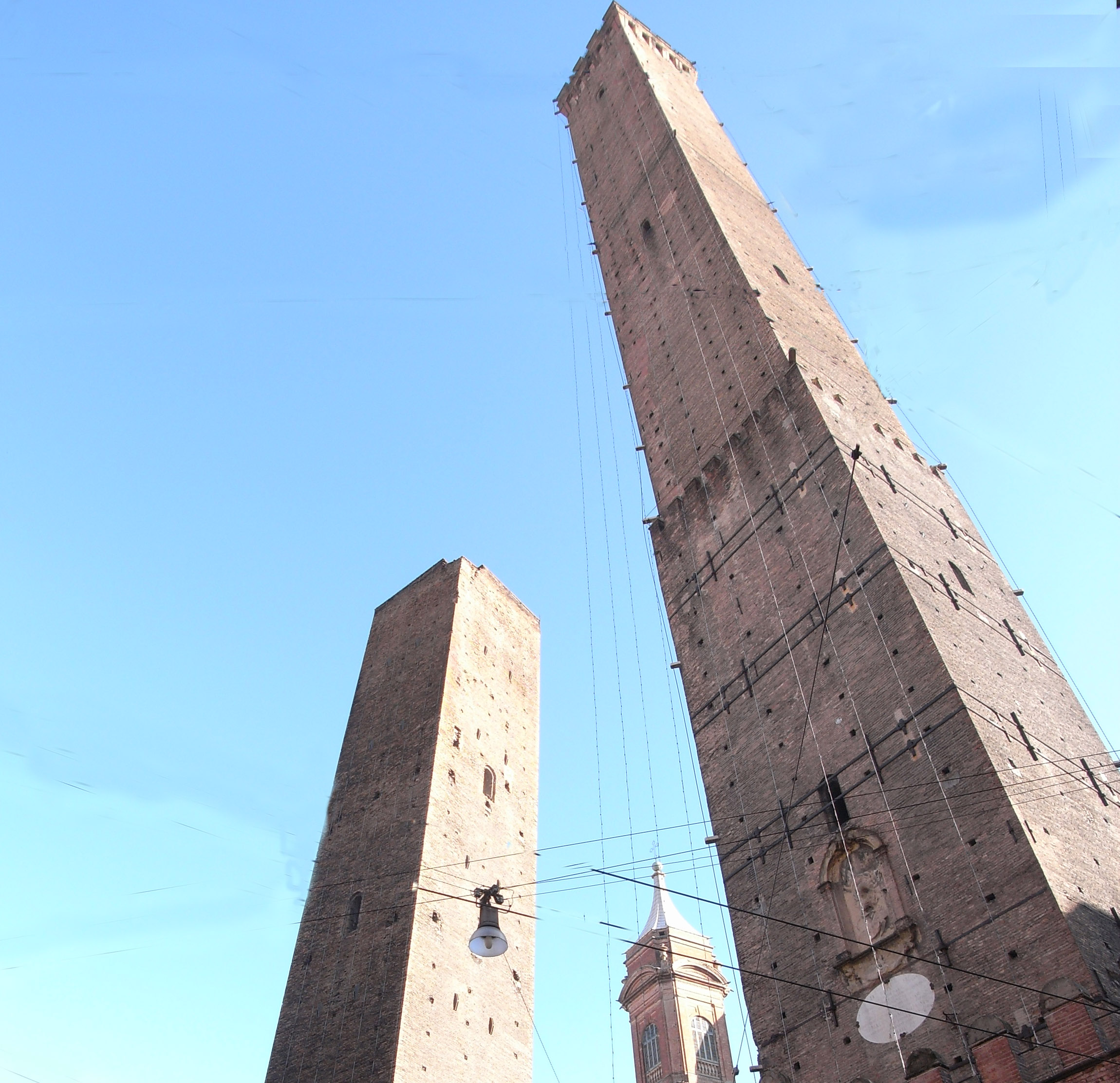
As part of this plan, Via Rizzoli, the wide thoroughfare that leads to the “twin towers”, was built. This created an opportunity for new construction.


In 1914, Palazzo Ronzani, at number 1 Via Rizzoli, was built for a local brewer after the demolition of a jumble of medieval buildings. It was known as the Palâz di Pistulén or ‘Building of the Louts’ after the young men who would gather under the portico and whistle at girls walking by.
Via Rizzoli

Ceramics by Arturo Colombarini (P. Granville)
Near the corner in Piazza Re Enzo is an original art nouveau shop front designed by architect Paolo Sironi who also designed a number of villas on the edge of the city.

Outside the building is a tram stop shelter built in 1921.

In the basement is a theatre which was later converted into a cinema. After being closed for many years, it reopened in 2023. It shows interesting classic films at reasonable prices. You’ll need to go to the nearby bookshop to buy tickets.


Further down Via Rizzoli at the corner of Via Castiglione, the Palazzo del Commercio was also built on land made vacant by the demolition of medieval buildings. On the ground floor is the Galleria del Leone or Lion Arcade, the first in Bologna and completed in 1928.

Here and there
Wandering around the centre of Bologna, you’ll come across other examples of Art Nouveau. Here are a few you can look out for.
There’s an attractive Art Nouveau style awning at 34 Via d’Azeglio.

In the early 20th century, this was a fashionable wine and pastry shop. A room inside has a ceiling painted in 1900 by Achille Casanova to represent a vine converted pergola. He was one of Bologna’s best known Art Nouveau style artists. At the time of writing it was part of a Starbucks coffee shop.

Walking down Via Ugo Bassi, you’ll come across the richly decorated brass clock made for the Bank of Rome.

There’s another attractive Art Nouveau style clock at at the corner of Via de’ Carbonesi and Via Val d’Aposa.

Completed in 1909, Palazzo Alberani at Via Farini 19 has a bass relief by Alfonso Borghesani on its facade, representing the sciences.

Palazzina Majani
The building at 4 Via d’Indipendenza, the work of architect and painter Augusto Sezanne, was built between 1904 and 1908 for the Bolognese chocolate maker Majani. On the ground floor was a bar, as well as a pastry and chocolate shop. Upstairs was a dance hall and the orchestra played from the open terrace. It was a favourite haunt of artists.

At the time of its construction, the building was very controversial, because of both the clash with the baroque style cathedral across the street ( see my post The Bell Tower of San Pietro, Bologna) and the way the large semicircular balcony broke the line of the surrounding porticoes.

With lingering memories of the long Austrian occupation of parts of northern Italy, one commentator described the palazzina as “a Viennese chair meant to trip pedestrians”.
In 1937, the interior was rebuilt in modernist style, only to be badly damaged by fire two years later. It remained a bar until 1953, and at the time of writing was home to a H&M store.
Nearby, at the corner of Via Rizzoli, the portico of Canton de’ Fiori has Art Nouveau style decoration both overhead and under foot.


Sala Borsa
Sala Borsa is located on the Piazza of Neptune. The space has served many purposes over the centuries, including a private garden for the Papal legate in the 14th century, a University botanical garden for over 200 years from 1568, a training ground for firefighters in the 18th century and a post and telegraph office. I described the current University botanical garden in a previous post.
The cast iron supported roof was built in the 1880s and the space became the stock exchange. In 1926, it was enlarged and remodelled to give it the appearance it has today. After serving many more purposes such as a bank, a sports venue and puppet theatre, it was transformed into a library in 2001.

You can see Roman ruins through the glass floor or go down the stairs at the left to visit them, as I described in my post Ancient Roman Bologna.
A little further afield
Towards the end of the 19th century, newly wealthy families were wanting to construct large houses, which was all but impossible in the old city. Implementation of the “garden city” aspects of the town plan catered to this need, and provided an opportunity for architects to design buildings in Art Nouveau style.
These “garden villas” featured wrought iron, tile and floral decoration.
Via Audinot
Located a 20 minute walk from the centre of the city, Via Audinot resembles a pocket of Art Nouveau Brussels transported to Bologna. A number of villas here are the work of architect Paolo Sironi from the period 1904-1910.


Other locations
Demolition of the city walls between 1902 and 1906 ( see my post The Walls of Bologna) opened up space where large residential buildings were constructed.

There are a number of villas with Art Nouveau decoration along Viale Carducci, but they are difficult to view due to surrounding trees and shrubs. The best known is the Casa dei Girasoli, or the House of the Sunflowers, at number 13/2. It’s another example of the work of Paolo Sironi.

There are glimpses of other residential buildings from the same period along the boulevards created after the demolition of the city walls.


The Certosa cemetery
My post, La Certosa- Bologna’s Fascinating Monumental Cemetery, includes a description of the cemetery and a sample of the monuments. A number are in Art Nouveau style.


Wandering around Bologna, as well as seeing some of the locations in this post, you’re sure to see other touches of Art Nouveau.
© P. Granville 2024
 Bologna on Foot
Terrific Paul, I really enjoy your perspectives on Bologna. Grazie mille!
LikeLiked by 1 person
Prego!
LikeLike