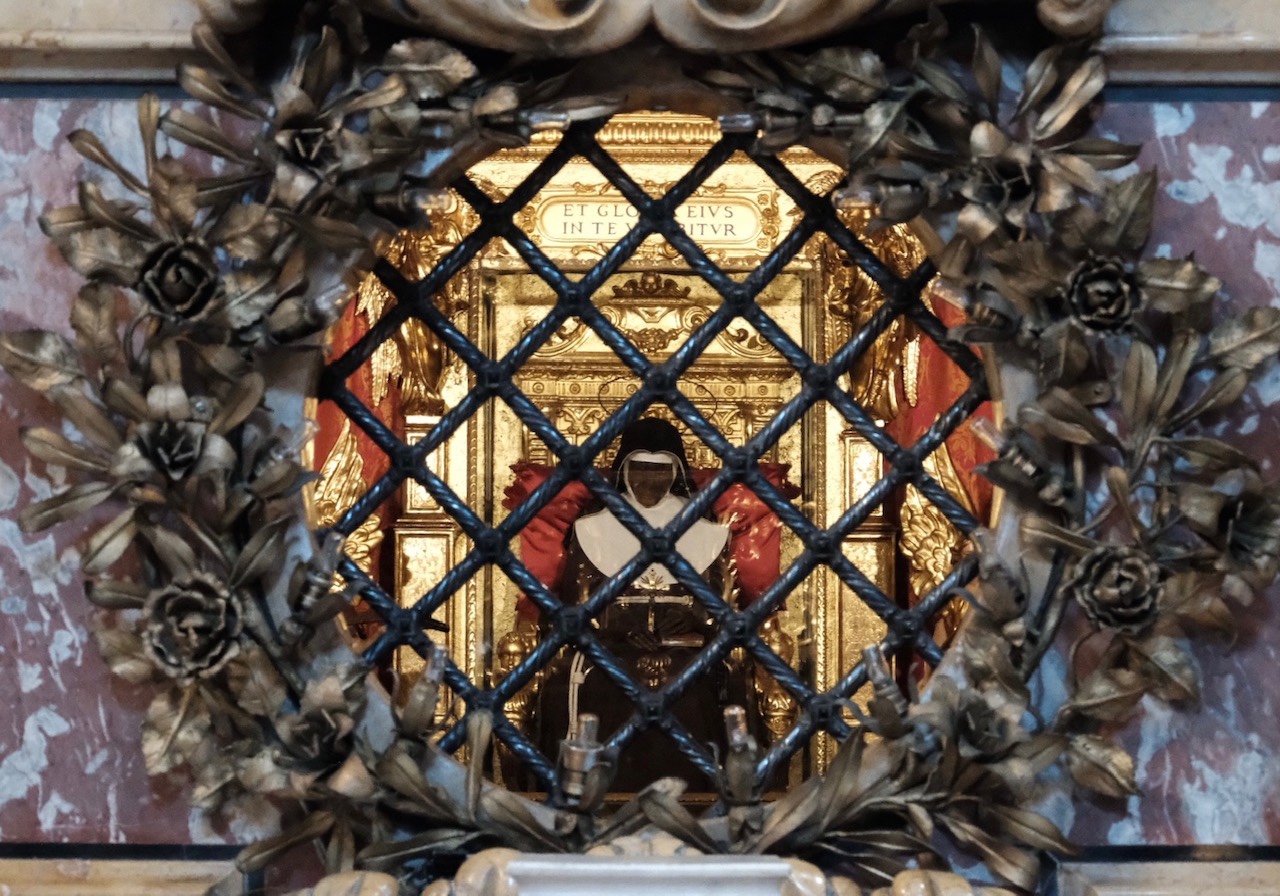
One of the more unusual places to visit in Bologna is the chapel containing the mummy of Saint Catherine of Bologna, who is also known as Saint Catherine de’ Vigri. Catherine or Caterina in Italian, was the Abbess of the community of Poor Clare nuns at the Corpus Domini convent in Bologna at the time of her death in 1463. She was buried in the convent graveyard, but exhumed 18 days later after the nuns noticed a sweet smell coming from the tomb.

Her skin was still white, but it has since darkened from centuries of exposure to lamps and candles. From at least 1529 to the present she has occupied a chapel at the church of Corpus Domini.
My post gives some of the details of the life of this mystic, author, artist, musician and abbess but to read about how to visit Bologna’s female patron Saint, skip to Visiting Santa Caterina.
Catherine’s early life
Caterina de’ Vigri was born in Bologna in 1413 to aristocratic parents Benvenuta Mammolini and Giovanni de’ Vigri. Her father occupied a position of importance in administration for Marquis Niccolò III d’Este in the town of Ferrara ( see my blog post A Day Trip To Ferrara)
In around 1424, Caterina became a lady-in-waiting to Margherita d’Este, an illegitimate daughter of Niccolò III, or according to some sources to his second wife Parasina Malatesta. Margherita and Caterina, who were almost the same age, became close friends and together received a good education for the time, including reading and writing Italian and Latin, music, calligraphy and painting.

Caterina was probably disenchanted with court life by the dissolute behaviour that she would have witnessed. Niccolò is said to have had 800 lovers and innumerable illegitimate children, including Margherita.


In 1425, using a maid as a spy, Niccolò confirmed his suspicions that his much younger wife Parisina and Ugo, his illegitimate son and heir, had become lovers. He had them both beheaded.

This tragic story was the basis of, amongst other works, a long poem by Lord Byron, operas by Donizetti and Mascagni and a 19th century painting by Girolamo Domenichini.

Not long after, Margherita married Galeotto Malatesta and moved to Rimini where her new father-in-law ruled. Barely a teenager, Caterina decided to leave the court to start a new life.
Religious life in Ferrara
Caterina joined a community of women in Ferrara who were leading a religious life without formally taking vows. After a split in the community, Caterina chose to become a member of the group that established the Poor Clare convent of Corpus Christi. The Poor Clares were founded by Francis and Clare of Assisi in 1212 and followed lives of communal poverty.

Caterina spent most of her life here, from 1431 to 1456, during which time she had a number of visions, such as one at Christmas in 1445 when the Virgin Mary showed her the baby Jesus.
She also wrote mystical texts, including “Le Sette Armi Spirituali” or “The Seven Spiritual Weapons”, written as a manual for novices. It contains descriptions of her visions of both God and Satan. She kept the text secret until she was close to death, after which it was published, became very well known, and was translated into 8 languages.

Caterina was also active in copying breviaries and illuminating them, which for her was a form of mystical meditation. Breviaries were books of prayers to be used at certain times of each day.


One author comments on Caterina’s illumination of her personal breviary. “The final result was a breviary with very personal iconographic inventions, decorated in a simple female style that followed the model of Clare, the needle woman, and evoked the humility of the Poor Clares’ vows”.
Abbess
In 1456, Caterina, who had become a well known figure and was Mistress of Novices in Ferrara, was asked to establish a new Poor Clare convent in Bologna.

She was abbess here until her death in 1463. As described above, 18 days after her death, her body was found to be preserved and was exhumed.

She was quickly beatified, a process in the Catholic Church that declares a person has entered heaven and can intercede on behalf of those who pray to them.

It wasn’t long before miracles were being attributed to Beata Caterina. Nuns would visit the sick of Bologna on request with water that had been used to wash her body and parts of her clothing. Miraculous cures were carefully recorded and would amount to 160 by the time she became a saint.
Caterina’s fame continued to grow and there were illustrious visitors such as Emperor Charles V and Pope Clement VII who were in Bologna for the emperor’s coronation in 1530.

Santa Caterina
After a false start to achieve her canonisation in the 16th century, around 70 years later the city’s noble families pushed for a resumption of investigations, based on Catherine’s uncorrupted body and the many miracles attributed to her.
By then, the Church had introduced a new process for determining if someone was indeed a saint which relied much more heavily on the opinion of doctors, and increased the importance of the role of the Promotor Fedei or devil’s advocate.

In Caterina’s case, three recently claimed miracles in particular were important, as the doctors’ testimony was that they had been unable to cure the maladies in question and the cures could only have been miraculous.
In 1671, to investigate the claim of her uncorrupted body, a group of eight eminent Bolognese physicians examined her head, neck, arms, feet and legs below the knee, which were considered the limits of decency.

A majority, including the internationally famous Marcello Malpighi, believed that a lack of flesh indicated that the body had merely dried out and was not uncorrupted. However, a group of 5 Bolognese noble women examined more of the body and reported that her breasts and thighs were still fleshy.
In the end, the three miracles carried the day and the issue of her uncorrupted body was dealt with by adopting the position that it had been uncorrupted, but wasn’t anymore.

Catherine was declared a saint in 1712.
Visiting Santa Caterina
Santa Caterina can be found in a chapel on the left side of the nave in the church of Corpus Domini, located at 19 Via Tagliapietre. This church was constructed in the late 15th century, however the interior was remodelled in the 17th century. It was badly damaged in a 1943 air raid that was targeting nearby military barracks.


After 567 years, interrupted only during the Napoleonic period, the Poor Clare nuns left the convent early in 2023, as their number had dropped to an unsustainable four. During visits to the Saint’s chapel, a little window would pop open revealing a nun who would admonish anyone being disrespectful. Now, lay volunteers manage the chapel.
As well as the Saint herself, the chapel contains numerous relics such as paintings, manuscripts and ex-votos. Of great interest to early music researchers is her small instrument usually referred to as a violeta. In the Franciscan tradition, music was important to the Poor Clares and a contemporary biography mentions Caterina, during a serious illness, asking for her violeta to play and praise with.


Just 49cm long, it is said to be the oldest surviving bowed string instrument in Europe. The only somewhat similar instruments appear in several of the paintings of Fra Angelico from the mid 15th century.

In 2015, it was examined in detail and a copy was made by a local luthier. Similarly to some folk instruments, it’s carved out of a solid piece of wood.


At the time of writing, the chapel and adjacent small museum were open on Tuesdays, Thursdays and Saturdays 10:00 – 12.00 and 16.00 – 1800 as well as on Sundays 10.00 – 11.15 and 16.00 -18.00.
There is also a view of Santa Caterina, whenever the church is open, through a round window on the left near the main altar.

© P. Granville 2023
 Bologna on Foot
Thanks Paul, I love these stories of the Italian towns, places & people. Super well researched too
LikeLiked by 1 person
Thanks Phill
LikeLike
Thanks for having so much information on her in one place, especially for those of us who will never get to visit.
St. Catherine of Bologna, please pray for creatives, especially visual artists and musicians.
Am sharing this on my Facebook page on her feast day.
LikeLiked by 1 person
teacher, devoted nun, dedicated artist, and spiritual oversea
LikeLike